
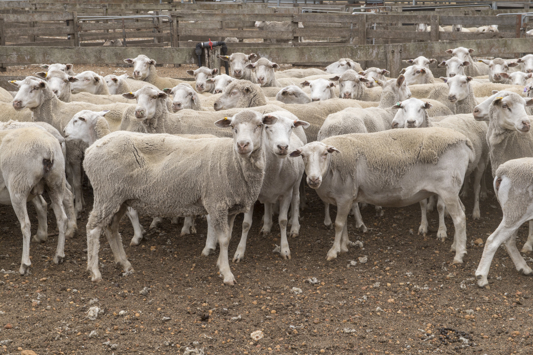
The Meat & Livestock Australia (MLA) Resource Flock involves the development of a reference population of sheep that underpins both genetic selection and genomic selection, particularly for hard to measure traits, including carcase traits like Lean Meat Yield, Shear Force and Intramuscular Fat. These tools are delivered through Sheep Genetics.
The MLA Resource Flock project commenced in 2012 and is run across 2 sites in Australia: one in the New England, NSW and the other at DPIRD’s Katanning Research Station.
A major industry success of the MLA Resource Flock is the development of Australian Sheep Breeding Values (ASBVs) for eating quality traits. The development of these traits has enabled sheep producers to select for animals that have high genetic merit for eating quality traits, along with high genetic merit for growth. These two traits have an unfavourable correlation. The genetic trend for eating quality in sheep meat was declining for many years, but after ASBVs were developed and used by industry for these traits, this trend has turned around, and the genetic merit of sheep for eating quality is now increasing with no impact on growth.
These flocks are used for additional research projects aside from the MLA Resource Flock, including the development of new traits, testing the effects of stress on meat phenotypes, and for the calibration and validation of carcase and eating quality measurement devices.
The current MLA Resource Flock program is a continuation on from the Cooperative Research Centre Information Nucleus Flock (2007-2012) and provides an ongoing sheep reference population.
Since the introduction of a national breeding evaluation program in Australian in 2000, the rate of genetic improvement in the sheep industry has been good for traits that are easy or cheap to record, but very poor for hard to measure (HTM) traits.
HTM traits are either too expensive to measure, can only be measured late in life or have no clear market signals and include improved eating quality, disease resistance, animal welfare, fertility, methane production and feed intake.
Genomic selection has the potential to change this dynamic, as it allows selection of young animals for both simple and HTM traits. However, prediction of genomic breeding values of selection candidates requires a reference population consisting of animals that have been phenotyped and genotyped.
Reference populations are required for each breed as genomic prediction across breeds is limited in value. To achieve genomic predictions that are moderately accurate, a reference population is required with thousands of animals measured.
Reference populations for HTM traits can be achieved by measuring HTM traits gradually from a few hundred animals from each breed.
A reference population of sheep was initiated by the Sheep CRC Information Nucleus program (2007-2011),
Over 5 years, the Information Nucleus flock gathered a massive database of biological and genetic information by joining 5,000 ewes each year to about 100 industry sires chosen for their genetic diversity.
The sheep were run as 5 sub-flocks, spread over 8 research stations around Australia. One of the largest sites was at DPIRD’s Katanning Research Station in Western Australia. Other sites included Struan and Turrettfield in South Australia, Hamilton and Rutherglen in Victoria and Trangie, Cowra and Armidale in New South Wales.
More data is required to improve prediction accuracy. This can be through a conglomerate of several different sheep flocks, involving different breeds and preferably located across a range of environments, such as in Katanning in the Great Southern region of Western Australia.
At the Katanning Research Station, sheep are DNA tested using a genotyping test to identify which genetic markers a sheep carries, and a wealth of data is recorded both prior to and after slaughter.
The results are used to identify genetic markers associated with production traits on individual sheep and estimate a genomic breeding value for traits that are too difficult or expensive to obtain in other ways.
Developing more accurate genomic breeding values improves accuracy when identifying superior breeding animals for Australia’s future sheep flock at a younger age.
The research has seen significant improvements in the accuracy of Australian Sheep Breeding Values (ASBV) of sires, especially for carcass and meat quality traits that are difficult to measure on live animals.
Process
- Approximately 1,000 ewes are inseminated with semen from about 100 industry sires at each site.
- The lambs are tagged with an electronic identification number at birth and mothered up with its dam. This technology has made it possible to collect much more data faster and more accurately on individual animals.
- All dead lambs are recorded as lamb mortalities, which is a significant point of inefficiency in sheep production systems. Learning why lambs die is an important step in understanding how to address this problem.
- Blood and other tissue samples are collected from each lamb and used to extract DNA.
- A wide range of visual traits such as body conformation and structure are collected at marking, weaning and prior to slaughter.
- Soon after weaning, the lambs are allocated to management groups.
- A wealth of data is recorded on each sheep prior to slaughter. This includes body weight and condition score from birth to slaughter and additional traits such as worm egg counts, scanning for eye muscle and subcutaneous body fat.
- At slaughter, carcass weights are recorded, as well as a range of measurements including various fat depth and eye muscle measurements, meat colour and pH.
- Meat samples are collected and tested for a wide range of meat quality traits that may impact on consumer preferences.
- All data is stored in a central database managed by Sheep Genetics. Information from relatives of the sires that were progeny tested is also used. This data influences the values and accuracy of sheep related to the sire. In this way, rams that contribute semen to the flock have a much wider influence on Australian Sheep Breeding Values (ASBV) than just their own performance.
Other related genetic projects underway at the Katanning Research Station include ‘Adding sustainability traits to the genetic research flock’ and the’Yardstick merino sire evaluation trial’.
This initiative expands the MLA Resource Flock to include measurement of new sustainability-focused traits, enabling the development of Australian Sheep Breeding Values (ASBVs) for these traits. This will provide the sheep industry the tools to reduce their environmental impact, improve efficiency and supports their ability to meet market expectations in relation to sustainability.
This project overlays the measurement of methane emissions and feed intake on the MLA Resource Flock. Progeny are tested using centralised, automated testing facilities and protocols, with data integrated into existing phenotypic and genomic evaluation systems to support development of future ASBVs and indexes.
To find out more about this project's results, benefits to industry, and future research recommendations, visit the MLA website.