
Research priorities
- Soil amelioration
- Soil re-engineering
- Sodic soils
- Post-amelioration management
- Crop nutrition
Priority projects
The department and the Grains Research and Development Corporation (GRDC) have entered into a 5-year strategic research collaboration with the aim of transforming water and nutrient use efficiency in WA grain production. Known as the SWAN (Soil Water and Nutrition) strategic collaboration, the department is investing $29.2 million, together with $26.7 million from GRDC.
State date: 01/07/2024
Finish date: 30/06/2029
Description
More than 85% of WA grain growers are actively improving their soils and about two-thirds of growers use deep soil tillage strategies, of which most are incorporating lime or gypsum. In addition, around 20% of WA growers regularly use lime or gypsum, without deep tillage.
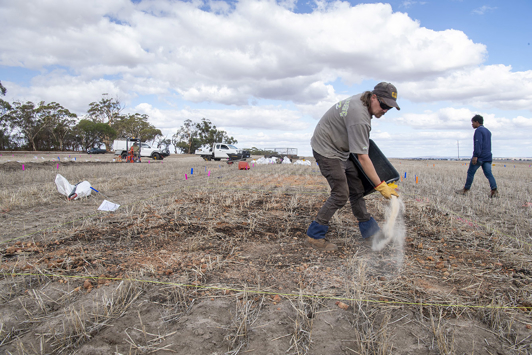
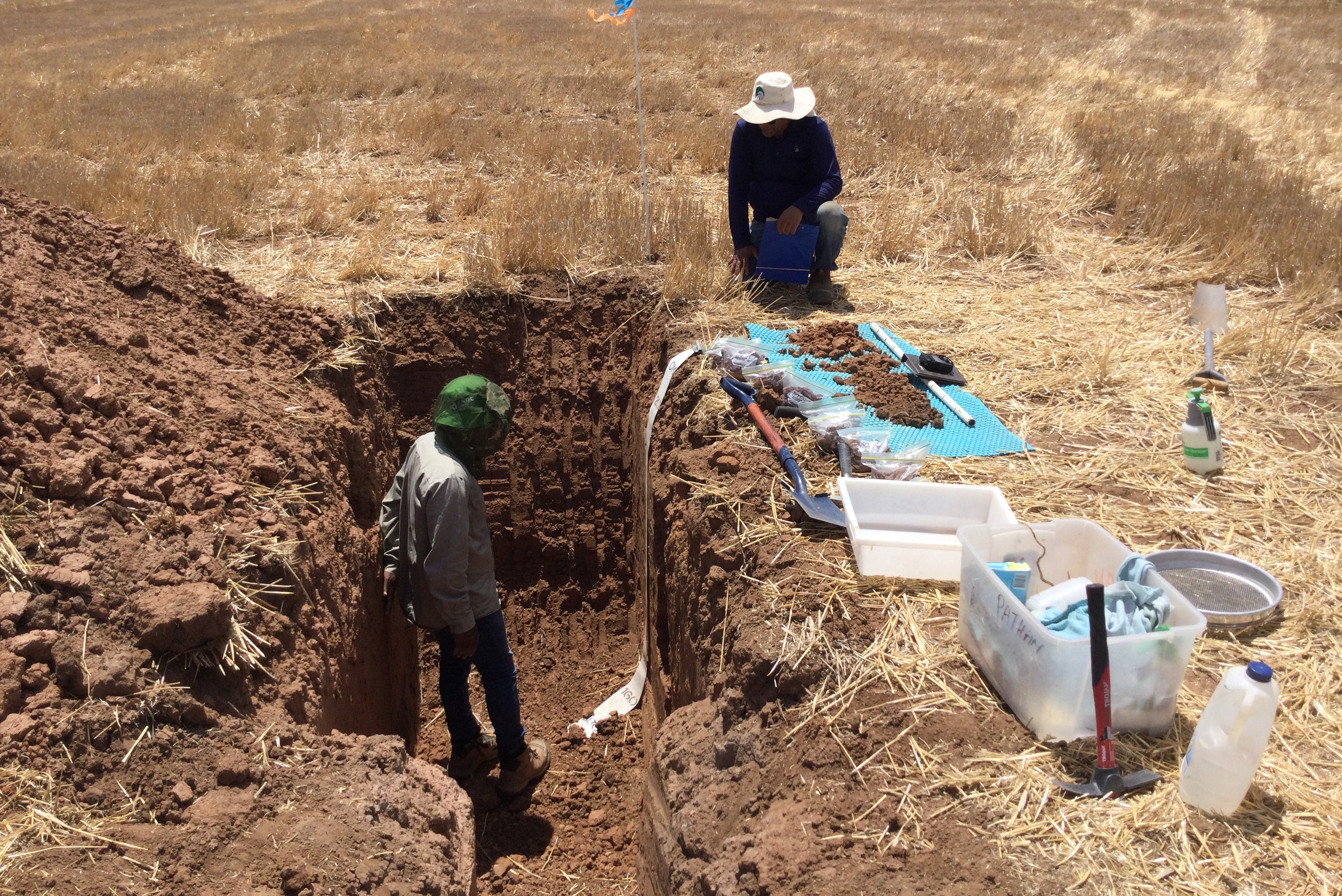
The SWAN partnership will investigate how deeper soil improvement - known as soil profile re-engineering - coupled with tailored crop nutrition, crop rotation and agronomic management can achieve further gains in water use efficiency and grain production. With the aim of achieving a step-change increase in crop water use efficiency and grain yield.
The initiative will build on 15 years of DPIRD soil improvement research, which shows deep mixing the soil and incorporating lime, gypsum, organic matter or clay improves crop water use efficiency and grain yields up to four-fold.
The project aims to help future-proof WA’s grains industry to support growers adapt to a drying climate and remain internationally competitive, by improving water and nutrient use efficiency to produce more, higher quality grain, profitably.
Project objective
To boost WA grain yields by increasing water use efficiency by more than 10% and improving crop nutrient availability by refining soil re-engineering and agronomy practices.
Overview
The SWAN strategic collaboration comprises three research programs with key deliverables managed by senior DPIRD soils scientists:
1. Novel and readily adoptable soil management approaches that overcome soil constraints to increase water use efficiency
- Program lead: Dr Gaus Azam
- Adoptable paddock-scale machinery and soil amendment options to implement soil profile re-engineering to 80 cm deep or more.
- Diagnostics and analyses on long-term productivity gains and financial returns to guide implementation of, and investment in, soil profile re-engineering strategies.
- Methods to improve water capture and reduce water loss on heavy-textured soils in low rainfall cropping regions.
2. Cost effective integrated nutrient management strategies that increase Nutrient Use Efficiency (NUE)
- Program lead: Dr Craig Scanlan
- Integrated nutrient management approaches that improve long-term nutrient availability and grain production in cropping systems.
- Management strategies to reduce potassium losses and improve availability of applied potassium in cropping systems for increased grain yield and reduced potassium deficiency in crops.
3. New knowledge, resources and adoptable technologies for growers and industry
- Program lead: Mr Wayne Parker
- Growers and industry provided with soil management strategies and packages that support industry adoption through investment analysis, implementation guidelines and approaches that improve and sustain soil function and productivity.
The collaboration will be overseen by a joint SWAN management committee comprised of DPIRD and GRDC senior research managers. Each of the research programs is managed by a senior DPIRD research scientist. The management committee and program managers are supported by a SWAN collaboration manager and administrator.
An Industry Advisory Group made up of leading Australian growers, consultants and researchers will help advise the strategic collaboration and ensure high impact and relevant industry and scientific outcomes are achieved.
Funding partner
GRDC
Project code
DAW2407-001SPX
Contact us
Dr Stephen Davies, SWAN Collaboration Manager and Principal Soil Research Scientist
t +61 (0)8 9956 8515 | stephen.davies@dpird.wa.gov.au
Wayne Parker, Senior Research Scientist, Soil
m +61 (0)429 080 074 | wayne.parker@dpird.wa.gov.au
Gaus Azam, Principal Research Scientist
t +61 (0)8 9690 2159 | m +61 (0)433 883 837 | gaus.azam@dpird.wa.gov.au
Craig Scanlan, Principal Research Scientist
t +61 (0)8 9690 2174 | craig.scanlan@dpird.wa.gov.au
This project will result in the grains industry having access to credible information summarising nitrogen (N) cycling and losses from key grain production systems and predictions of nitrogen losses and their potential environmental impact.
State date: 1/04/2023
Finish date: 1/07/2026
Description
Fertiliser inputs, dominated by nitrogen, represent about a third of the costs production for most grain producers.
The proportion of fertiliser nitrogen recovered by the crop within the season it is applied is typically small and variable and, in some cases, there is a poor understanding of fertiliser nitrogen not accounted for in the soil, grain, and crop residues at the end of the season, which is assumed to be lost from the system. Moreover, intensively cropped soils have declining organic matter (OM) content, and many farms have negative nitrogen balances.
Limited data and knowledge suggest growers can't rely on pulses alone to increase soil organic matter and nitrogen supplies, and long-term legume pastures are needed. The timing and placement of fertiliser application are important.
An increasing reliance on fertilisers to supply nitrogen to cereals and canola often results in considerable amounts of mineral nitrogen in the soil that are prone to several loss pathways with potential to impact the environment, especially in high rainfall conditions.
This 5-year project will collect a comprehensive data set of nitrogen balance and cycling, with explicit measurement of loss pathways, to address key gaps in data for the most important soil types and farming systems across Australia's grain growing areas.
Extending detailed nitrogen measurements from a limited number of sites to represent the national grains industry will require the use of models. Consequently, the data collected will be also used to enhance and augment the relevant nitrogen routines in the APSIM NextGen crop and soil model.
Funding source
GRDC-PA
Project code
UOQ2204-010RTX
Contact us
Craig Scanlan, Principal Research Scientist
+61 (0)8 9690 2174 | Email Craig Scanlan
-
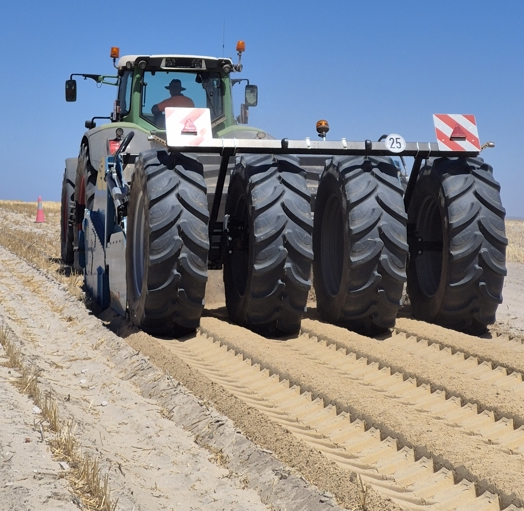 DPIRD's soil team working with growers on next generation spaders, with working depths to 1 metre, to determine value of the soil transformation
 -
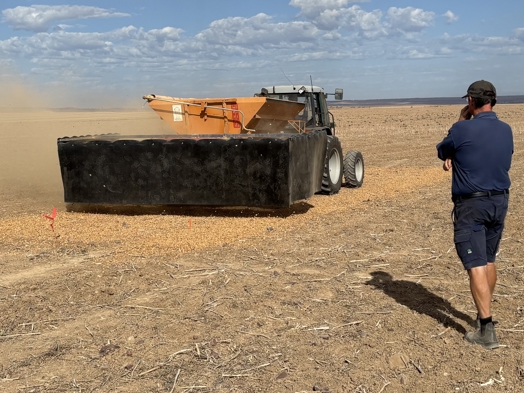 Investigating new techniques for sustainable production - applying gravel mulch to a high clay soil to determine its ability to reduce evaporation