
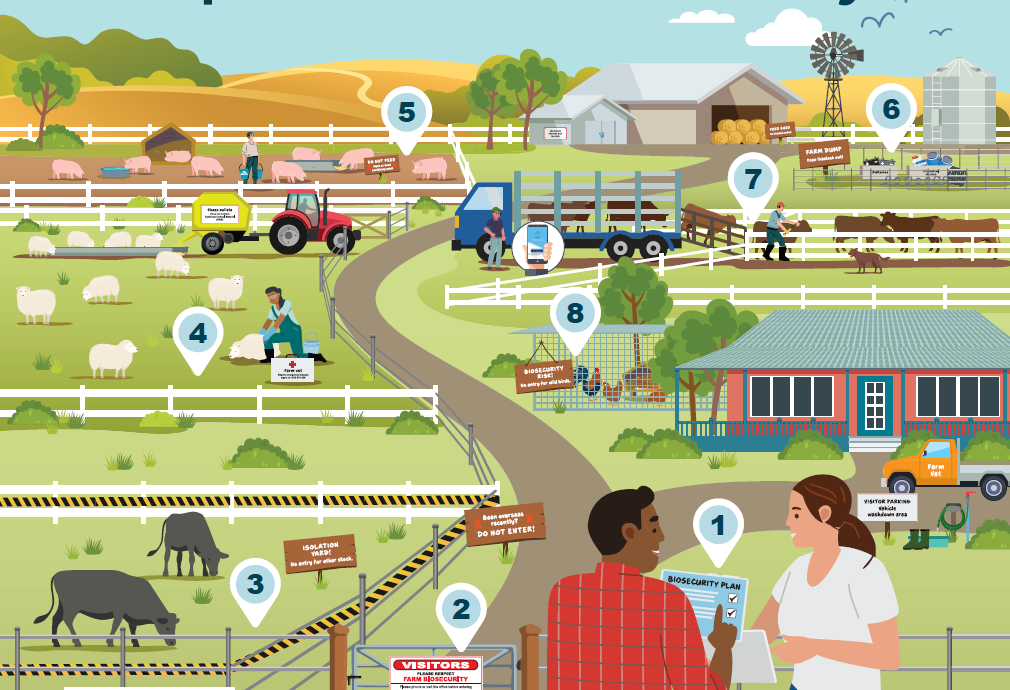
If you live, work on, or visit a farm, you have an important role to play in biosecurity.
Follow the biosecurity steps below to help reduce the risk of an emergency animal disease or residue occurring on your farm. In the case of disease, these steps will also help minimise spread.
A biosecurity plan describes your farm, the biosecurity risks, and the actions that will be taken to reduce the risk. The plan should be reviewed every 12 months or earlier if there are management changes or a disease occurs.
The Farm Biosecurity website (farmbiosecurity.com.au) has a comprehensive workbook that steps users through the process as well as quick reference guides.
People entering or returning to your farm, including family members, visitors, workers, stock agents, veterinarians and transporters, can all carry diseases with them through contaminated vehicles, equipment, feed, boots, clothing and even their food.
To reduce the risk:
- Install biosecurity entry signage.
Examples include:- Do not enter unless prior approval received. Phone xxxx xxxx before entering.
- Do not enter if you have been overseas in the past 7 days.
- Follow marked roads.
- Provide clearly marked visitor parking, boot cleaning and vehicle washdown facilities. Ask visitors to clean their boots at the wash bay or provide clean gumboots to wear.
- Limit visitors to your livestock where possible.
- Provide training to workers and regularly check they are following biosecurity protocols.
- If you have pigs or poultry, encourage handlers to get an annual influenza vaccination.
- If workers are sick, they should not have contact with livestock, especially pigs.
- Ensure workers / visitors do not bring or leave food into areas where livestock or feral animals may be present.
- Keep a visitor register, including their contact details for traceability.
Bringing in new livestock, including rams or bulls for mating, represents a biosecurity risk that should be managed.
- Only buy from reputable producers, and ask for an animal health declaration before buying.
- Isolate newly bought, agisted or sick livestock to reduce the risk to your existing animals.
- The isolation yard should have a ‘No entry-isolation yard’ sign, and a buffer zone between the yard and other livestock to reduce the likelihood of direct contact or aerosol spread if stock do develop a disease.
- Check new or sick stock daily for signs of disease.
- Feed and water isolated stock after you have tended to your existing animals OR
- Wash your hands, change clothes and clean and disinfect boots and any equipment used before having contact with your other stock.
Monitor livestock regularly for signs of disease. If multiple animals become sick or die or show unusual disease signs or behaviour, act immediately.
It is a legal requirement to report suspicion of an emergency animal disease and early reporting can help limit the spread and resulting impact.
To report unusual disease signs or multiple animal deaths, call your local vet or DPIRD field vet, or the Emergency Animal Disease hotline on 1800 675 888.
Where livestock show signs similar to an emergency animal disease, the case may be eligible for a subsidised laboratory investigation under the Significant Disease Investigation Program. This will help rule out emergency animal diseases and find the cause, while at the same time providing evidence that Australia is free of emergency diseases.
Find out more about emergency animal diseases, including disease signs.
Feed can introduce emergency animal diseases to your livestock in a variety of ways:
Prohibited pig feed (swill):
- It is illegal to feed pigs with meat, or food that has been in contact with meat, because it can cause devastating diseases such as foot-and-mouth disease and African swine fever.
- Only feed pigs commercial pig pellets, and grains, fruit and vegetables that have not had contact with meat.
Restricted animal matter (RAM):
- It is illegal to feed RAM to ruminants (cattle, sheep, goats, deer, camels, alpacas).
- Feeding RAM could cause transmissible spongiform encephalopathies in these animals, such as bovine spongiform encephalopathy (mad cow disease) in cattle or scrapie in sheep. These diseases are a human health risk and would close down Australia’s livestock markets.
- RAM is anything that comes from animals, including fish and birds (except gelatine or milk products).
- If buying manufactured feed for ruminants, look for the ‘Does not contain RAM’ label.
- Store feed for ruminants away from any other feed that contains RAM.
- Ensure your ruminants cannot access feed sheds containing RAM.
- When you buy stock feed, ask for a commodity vendor declaration that declares the feed is suitable for livestock.
- When buying in or feeding your own hay, ensure it has been tested for annual ryegrass toxicity (ARGT) with negligible or low-risk results.
Incorrect chemical use or livestock accessing chemicals, machinery, batteries, lead paint or farm dumps can result in residues that could impact human health and our livestock markets. To prevent residues:
- Follow all directions on chemical labels and record all chemical usage. You are legally required to keep records of the following information for 3 years:
- individual animal or group identification
- name of the product
- date of administration
- dose administered
- treatment period
- withholding period.
- Record chemical usage on the National Vendor Declaration when selling stock within the withholding period and record all stock movements.
- Securely fence or store materials that could cause a residue or poisoning in livestock, including:
- veterinary chemicals, chemical drums
- lead-containing materials: farm dumps, machinery sheds, machinery, batteries (old batteries are high risk), old buildings, painted fencing, posts painted with sump oil.
Find out more about veterinary chemicals and the prevention of chemical residues in livestock.
Livestock traceability is critical to good biosecurity and farm management. Without up-to-date traceability, an emergency animal disease response would be slower, potentially allowing further disease spread and / or unnecessary restrictions.
Traceability assists with disease management, residue tracing, food safety and maintaining product integrity – all essential for access to export markets.
Livestock include cattle, buffalo, sheep, goats, pigs, horses, deer, alpacas, llamas, vicuna, camels and poultry.
All owners of livestock in Western Australia must:
- register with DPIRD and obtain a property identification code (PIC)
- identify livestock correctly (see webpage below for species identification rules).
For movements of sheep, goats, cattle, buffalo and pigs:
- complete movement documents whenever stock leave a PIC
- update the National Livestock Identification System (NLIS) or PigPass database.
Find out more about traceability requirements for each species.
With high pathogenic H5 avian influenza (H5 bird flu) moving closer to Australia, now is the time to review your poultry biosecurity. Key biosecurity actions to take include:
- Keep wild birds away from poultry and their food and water by using housing or netting.
- Use town water or treated water sources.
- Regularly clean food and water containers, equipment and housing.
- Clean boots and wash hands before and after visiting poultry.
- Register with DPIRD as a livestock owner if you own 50 or more poultry or 10 or more ostriches or emus.
- If you see multiple sick or dead poultry, contact your local vet, DPIRD field vet or the Emergency Animal Disease hotline on 1800 675 888.
Find out more about poultry biosecurity and avian influenza.
Stay informed
Stay informed about livestock disease and residue threats, traceability and relevant biosecurity events:
- bookmark the Animal biosecurity webpage
- chat to your local DPIRD field vet or biosecurity officer
- follow DPIRD’s social media accounts
- subscribe to our newsletters.
-
8 steps to biosecurity factsheetpdf (415 KB)
-
Farm biosecurity guide for contractorspdf (447 KB)