
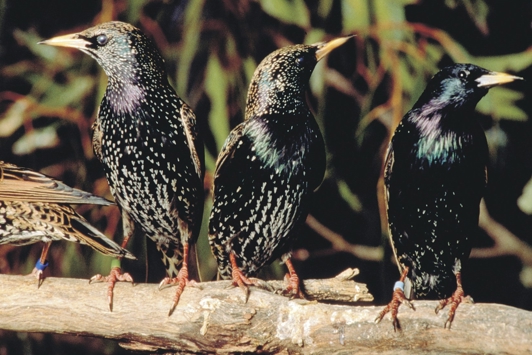
The European starling (Sturnus vulgaris) is native to Europe, Asia, and North Africa, the species has successfully established widespread populations on every continent, except Antarctica.
It is a medium sized bird with the potential to cause major agricultural, environmental and social impacts if they establish.
They are omnivorous birds which will feed on a wide variety of invertebrates, seeds, and fruit and they can form large, aggressive flocks which out-compete native birds.
European starlings are a declared pest in WA and the keeping of starlings is prohibited.
European starlings must be reported to DPIRD if found or suspected to be present in Western Australia.
Pest plan
The Department of Primary Industry and Regional Development (DPIRD) has successfully prevented starlings from establishing in WA. Although starlings have been recorded as early as 1917, it was not until the 1970s – when increasing numbers of birds began arriving – that an annual, targeted control program was introduced.
DPIRD recognises that the early detection and eradication is crucial in preventing the establishment of the species.
This plan outlines the activities to be undertaken by DPIRD from 2026 to 2031 to maintain WA’s status as free of established starling populations.
DPIRD recognises the importance of the support from landholders and communities across the impacted regions and will continue to work collaboratively to minimise the risk of starlings establishing in WA.
More information
The European starling is a declared pest in WA and is prohibited under section 12 of the BAM Act. It is assigned to control category C2 (eradication) in the Shires of Esperance and Ravensthorpe, and control category C1 (exclusion) across the remainder of WA; however, the objective is to prevent the establishment of wild populations in WA, regardless of the category assigned.
The keeping of starlings is prohibited.
Starlings pose a significant threat to primary industries by:
- damaging fruit and grain crops through feeding
- contaminating livestock feed, water sources and wool with their droppings
- reducing product quality and increasing management costs
- having the potential to spread livestock diseases.
Environmental impacts:
They affect native ecosystems by:
- competing with native fauna, both birds and marsupials, for resources;
- displacing native species and reducing biodiversity;
- altering ecosystems by affecting native plant and insect populations.
Social impacts:
In urban areas large starling flocks create significant nuisance and economic costs through:
- fouling and damaging infrastructure, buildings and public spaces, with their corrosive droppings
- constant and high level of noise and odour from large roosting flocks.
Globally, they are recognised as one of the world’s 100 worst invasive species.
Starlings represent an extreme risk to the economy, environment, and community of WA. A scientific risk assessment conducted by the department confirmed starlings have extreme potential for widespread establishment in WA and to become a significant pest here. An analysis of the economic impact of starlings to WA showed that it was cost-effective to prevent their widespread establishment.
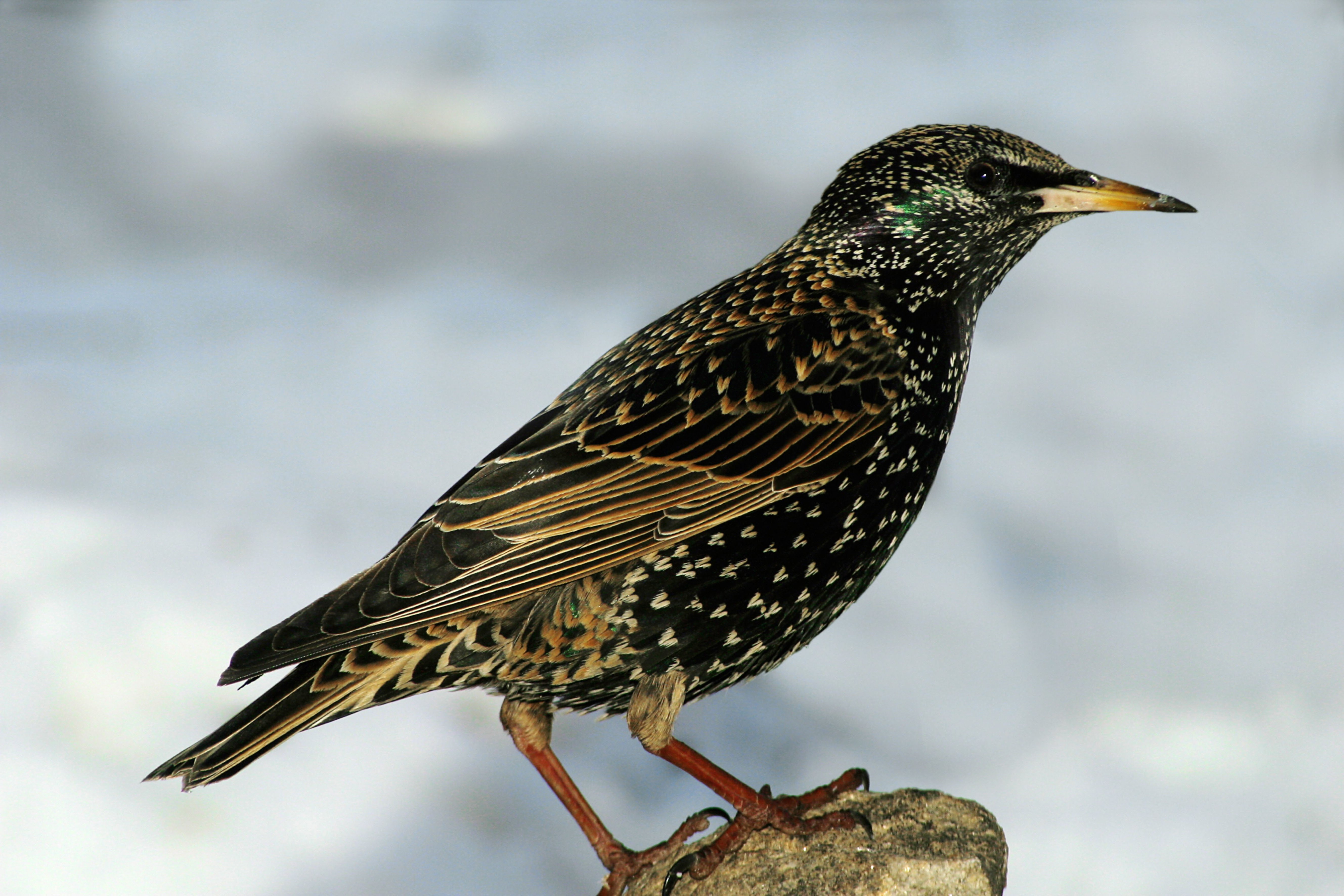
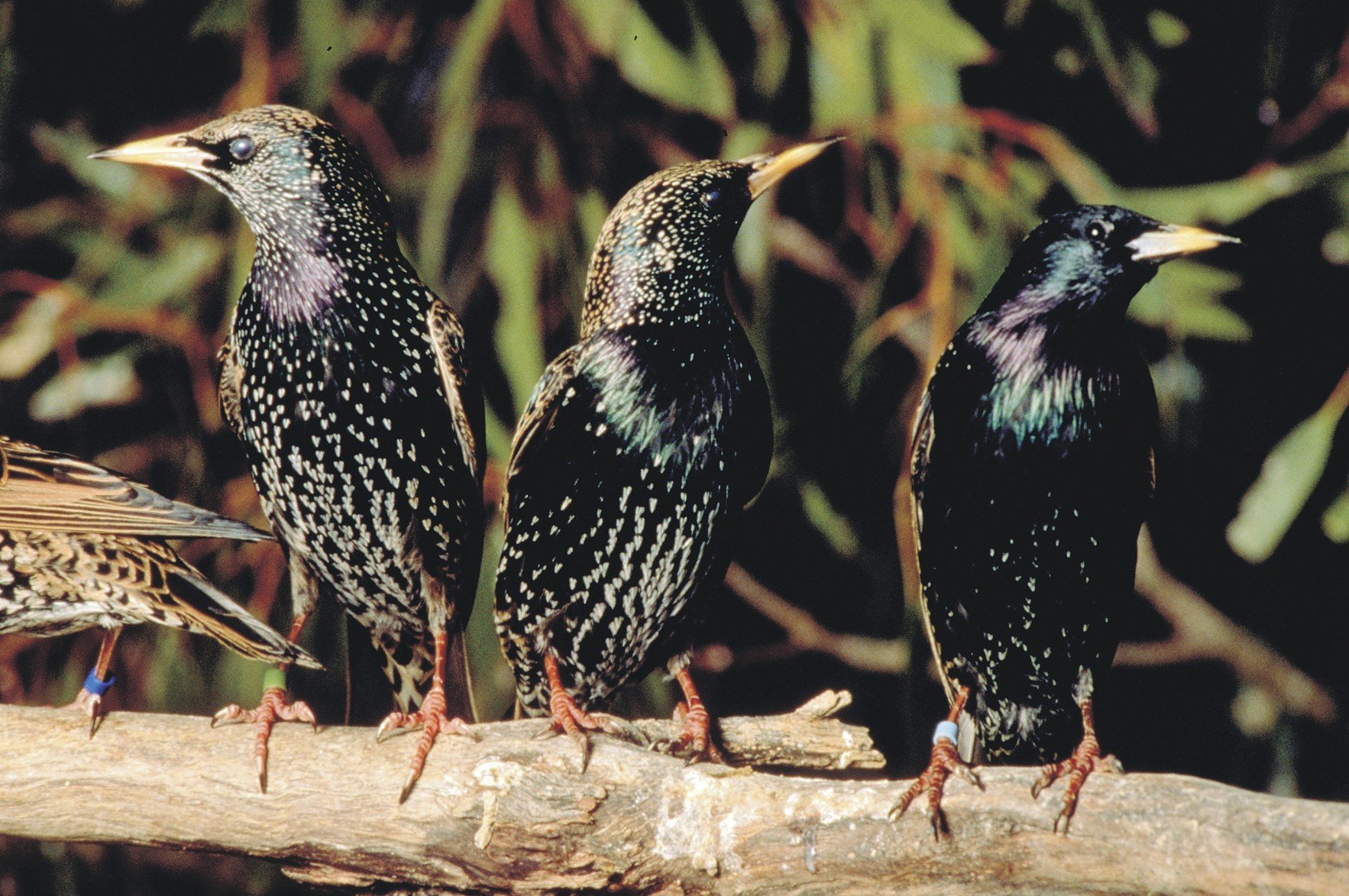
- medium sized passerine bird, approximately 20 cm long with glossy black plumage with a metallic sheen, speckled with white a certain times of the year
- younger birds have browner plumage than the adults
- often perch on sheep’s back.
Hear the sound of the starling's call
Where they live
Common starlings are strongly associated with human-disturbed habitat, such as farmland and cultivated areas. However, they can also live in a wide range of rural and urban habitats, including open country or grasslands, wooded regions, swamps, parks, towns, and cities.
How they behave
Starlings are aggressive, social birds and can form very large flocks that move, feed, and roost together. On the ground, they walk jauntily or run rather than hop like many other birds.
They are often associated with livestock and can be seen perched on the backs of animals or on the ground among grazing stock. Starlings are proficient songbirds and can mimic the calls of many other birds.
What they eat
Starlings have a varied diet that includes insects, spiders, seeds, grains, fruit, livestock feed, and food waste. To breed successfully, they need to eat insects, but plant food is also readily consumed.
Starlings feed mainly on the ground where they pick up food items off the surface and probe into the soil with their strong beaks. They also pick food items off vegetation, catch flying insects, and pluck whole or pieces of fruit from trees and vines. Newly sown seed is uncovered and eaten from paddocks. Starlings prefer short grass when foraging, and grazed pastures provide ideal feeding sites.
Reproduction
Starlings can breed across a wide range of habitats. In Australia, they breed from July to March, and can have up to 3 broods per year. Nests are built in any available cavity, often in tree hollows or buildings. The nests are constructed of dry grass combined with assorted other material, including twigs, leaves, and feathers. Four to 5 light-blue eggs are laid, which hatch after 13 days. The young remain in the nest until 3 weeks of age.
The department runs a seasonal surveillance and trapping program in the south-east of the state to prevent the encroachment of starlings from South Australia, where this introduced pest bird is established.
The department’s surveillance and control work aim to prevent starlings from establishing permanent populations in WA and to eradicate incursions when located. We also work with South Coast NRM and Esperance Bird Observers Group volunteers to assist with surveillance efforts.
We work closely with the community and rural landholders on starling control, encouraging community members to be vigilant and report any usual activity, such as birds on the back of livestock or groups of black birds flying in tight groups.
Other than willy wagtails, starlings are one of the few birds that will stand on the back of livestock in Australia.
In the past, small populations of starlings have established in the south-east of WA, near the towns of Munglinup and Condingup.

Although starlings are distinctive in appearance, they can be confused with similar-sized native species that use similar rural habitats.
Mistaken identity
The following is a guide to identifying European starlings, which summarises key features to look for to differentiate the starling and 3 similarly sized native species: dusky woodswallow, yellow-throated miner, and purple-crowned lorikeet.
Source
Handbook of Western Australian Birds – Volumes 1 and 2, Johnstone and Storr, 1998; 2004 Western Australian Museum.
European starlings
Appearance
- Sized about 19 to 22 cm in length, and weighs between 38 and 80 g.
- Plumpish or stocky, dark-coloured bird with a short square tail and a straight, pointed bill.
Key features
- Dark, stocky looking bird, usually seen in groups and often around livestock.
- Flies fast with rapid wing movements, interspersed by short glides.
- Flocks often seen wheeling and turning quickly in tight silent groups, which makes them recognisable from a distance.
Dusky woodswallow
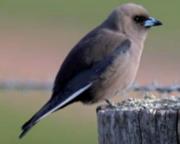
Photo - courtesy Kevin Vang© 2007
Appearance
- Sized about 17 to 19 cm in length, and weighs between 33 and 35 g.
- Compact bird with dark, grey-brown body.
- Chubbier looking than a starling with shorter legs and bill.
- Long tail.
Key features
- Has obvious white edging to wings and tail.
- The bill is short and blackish in colour.
- Flight is graceful but rapid, interspersed with periods of gliding.
- Has a soft chi chi in-flight call.
- Often seen in communal huddles or side by side along a tree branch.
Yellow-throated miner
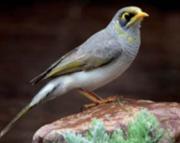
Photo - Tony Crittenden© 2007
Appearance
- Sized about 23 to 27 cm in length, and weighs between 53 and 61 g.
- Medium-sized honeyeater.
- Mostly pale, grey-brown body with white rump and underparts.
- Has short, rounded wings, and a longish tail.
Key features
- Noisy, gregarious, and aggressive to other birds.
- Frequently visits water troughs to drink and bathe.
- Has bright yellow skin above and behind eye, the bill is also yellow.
- In flight, they usually follow each other in a line and do not form tight flocks like starlings do.
- Loud, harsh alarm call, tew-tew-tew or teu-teu-teu.
Purple-crowned lorikeet
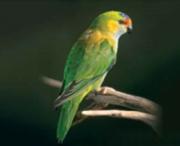
Photo - courtesy John Milbank© 2007
Appearance
- Sized about 16 to 18 cm in length and weighs about 42 to 50 g.
- Small green parrot (larger than a budgie) with largish head and pointed, stubby tail.
- Has a small purple patch on crown and orange on forehead and cheeks.
Key features
- Usually only seen when flying in small-to-large flocks, as not easily seen at close range.
- Flocks can resemble those of starlings in that these lorikeets fly and turn quickly in a tight group.
- Flight is swift and direct with rapid, whirring wing beats.
- Can be heard calling ‘zit’ or ‘tsit’ continuously when in flight (unlike starlings).