
Skip to main content Skip to navigation

Cat's claw creeper

Learn the signs and how to make a report if you find or suspect the presence of Cat’s claw creeper in Western Australia.  

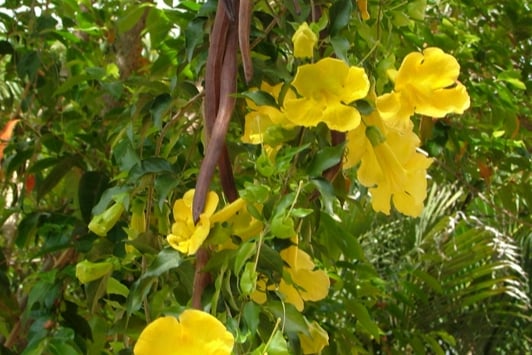
Cat's claw creeper ©State of NSW

Cat’s claw creeper (Dolichandra unguis-cati) is native to tropical central and south America. It is a long-lived woody creeper with claw-like tendrils under the leaves and large tubular yellow flowers.

Cat’s claw creeper is a declared pest in WA and must be reported to DPIRD if found or suspected to be present in Western Australia.

What to look for

  • woody vine with climbing stems and underground tubers
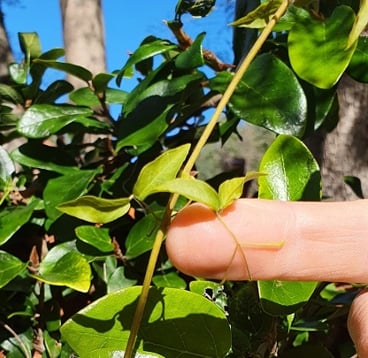
  • leaves – compound, oppositely arranged on stalks 5 to 25 mm long. Leaflets are paired, oval to elongated, with a third leaflet modified into a tendril with 3 small claws, each 3 to 17 mm long.
  • flowers – bright yellow, tubular with 5 lobes, appearing in spring and summer
  • fruit – long, narrow pods that turn dark brown as they mature, containing numerous papery winged seeds.

The Cat's claw creeper biosecurity alert provides more information.

What damage can this pest cause?

Cat’s claw creeper (Dolichandra unguis-cati) is a biosecurity threat due to its highly invasive and adaptable characteristics impacting waterways, forests and urban environments.

The creeper alters native environments and ecological communities and especially impacts forestry and infrastructure such as power poles and lines. It hampers access tracks as it tends to follow trails and pathways. In urban environments it will cover sheds, fences and roofs. It is extremely difficult to remove due to the tendrils and aerial roots that adhere to surfaces often creating further damage. 

Pest plan

The Department of Primary Industries and Regional Development (DPIRD) has been preventing cat’s claw creeper establishing in Western Australia (WA) since 2003, but small outbreaks continue to be detected. 

DPIRD recognises that the early detection and eradication of these small outbreaks is crucial in preventing the spread of the weed. 

The Cat’s claw creeper plan outlines the activities to be undertaken by DPIRD in controlling and managing cat’s claw creeper in WA over the next 5 years. As there are so few reports of cat’s claw creeper found in WA, eradication is still considered feasible.  

DPIRD recognises that landholders, local government and other state government agencies play a key role in assisting with the early detection and control of cat’s claw creeper.
Legal duty to report

Cat’s claw creeper is a declared weed under section 12(1) of the BAM Act and is assigned to control category C1, denoting the plant is to be excluded from the state and eradicated when found. 

As a prohibited declared weed, cat’s claw creeper is not permitted to be propagated or sold in WA and any plants found are to be eradicated. All landholders have a legal obligation to control a declared species under the BAM Act.  

Report suspected pest or disease

Early detection and reporting will help protect Western Australia's industries. If you find or suspect the presence of this pest or disease, report it in one of the following ways. 

Documents

  • Factsheet: Cat's claw creeper biosecurity alert
    pdf (3.31 MB)
  • Cat's claw creeper pest plan
    pdf (1.19 MB)

    Plan outlines the activities to be undertaken by DPIRD in controlling and managing cat’s claw creeper in WA over the next 5 years.

Related links

  • Search WAOL

    The Western Australian Organism List (WAOL) provides the status of organisms which have been categorised under the BAM Act 2007.

  • Visit PaDIS

    PaDIS provides advisory and identification services on animal and plant pests, weeds and diseases that impact WA's agriculture and food industries.

Contact us