
Latest updates and advice
- The seasonal climate outlook for the months of August and September 2026 indicates below median rainfall and higher temperatures for the majority of the state.
- Rainfall and soil water maps are available below for the 2026 season so far.
- Explore how to adjust inputs to maximise economic yield potential, not just crop yield. Tune in to Grains Convo episodes on balancing yield and profit this season.
- Reports of high mouse activity in WA’s agricultural regions mean growers should closely monitor paddocks and consider using registered bait where activity is high.
- Monitor livestock during lambing, watching closely for hypothermia, mismothering and metabolic diseases such as pregnancy toxaemia and hypocalcaemia.
Climate outlook
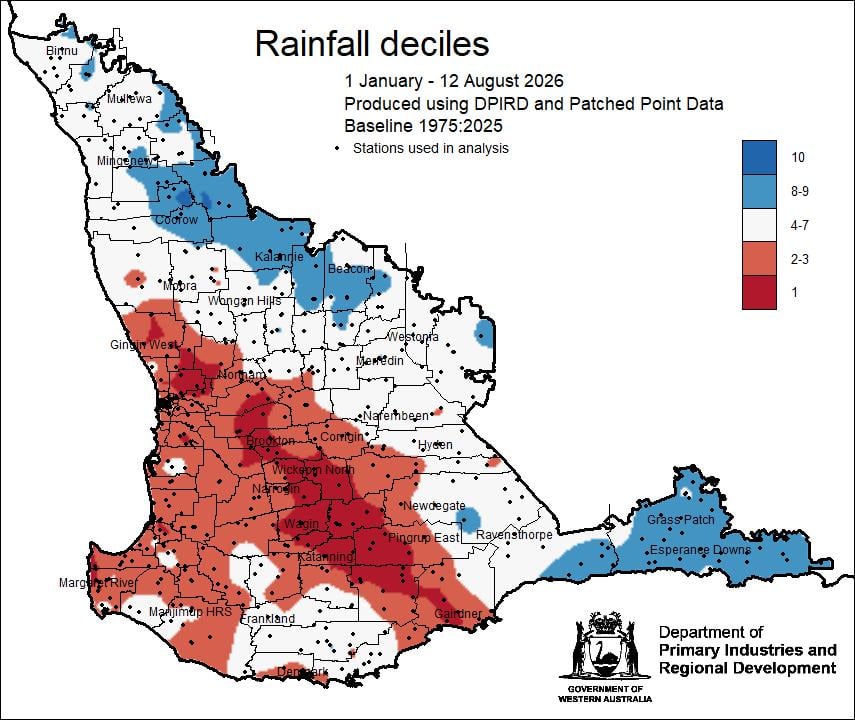
- Rainfall since January has been above average in the Kimberley and northern parts of the Pilbara, average to below average in the Gascoyne. For the South West Land Division rainfall has been variable, with some parts receiving above average rainfall, while parts of the Great Southern are below decile 3.
- Rainfall and soil water maps are available below for the 2026 season so far.
- The seasonal climate outlook for August to October 2026 continues to indicate the El Niño in the Pacific Ocean lasting until at least summer. There is a potential of a positive Indian Ocean Dipole developing during spring. Together with high-pressure systems the current outlook is for drier and warmer temperatures across the state.
- Check out the August edition of the Seasonal Climate Outlook newsletter for the South West Land Division (SWLD).
- Use the Rainfall to date tool to visualise cumulative rainfall from the start of the grain growing season and inform decision making.
Recent rainfall and soil water maps (2026 season)
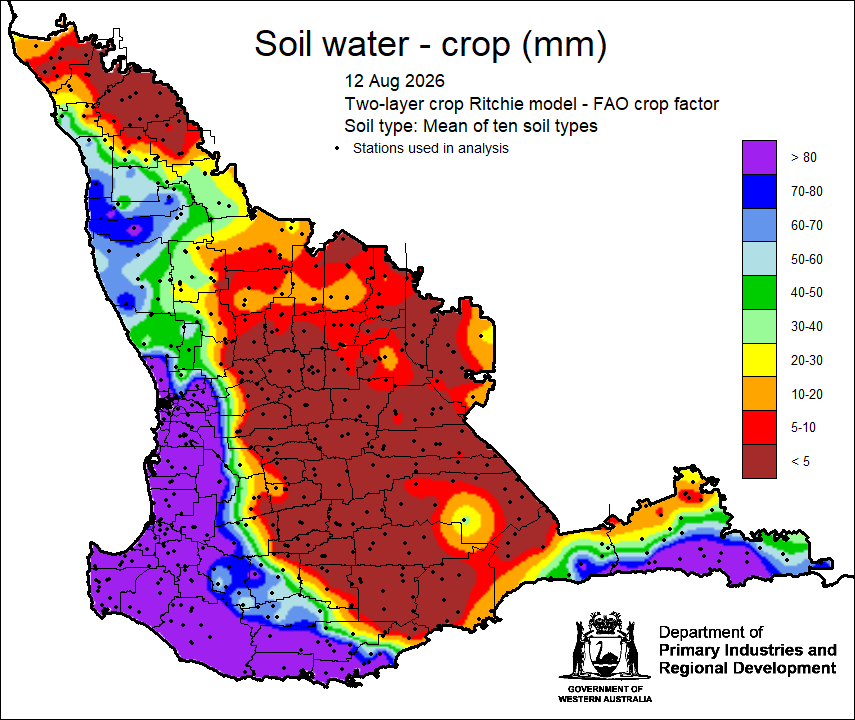
Updated maps provide a snapshot of seasonal conditions across Western Australia, including rainfall totals, how this season compares to historical records, and estimated soil water availability for crops.
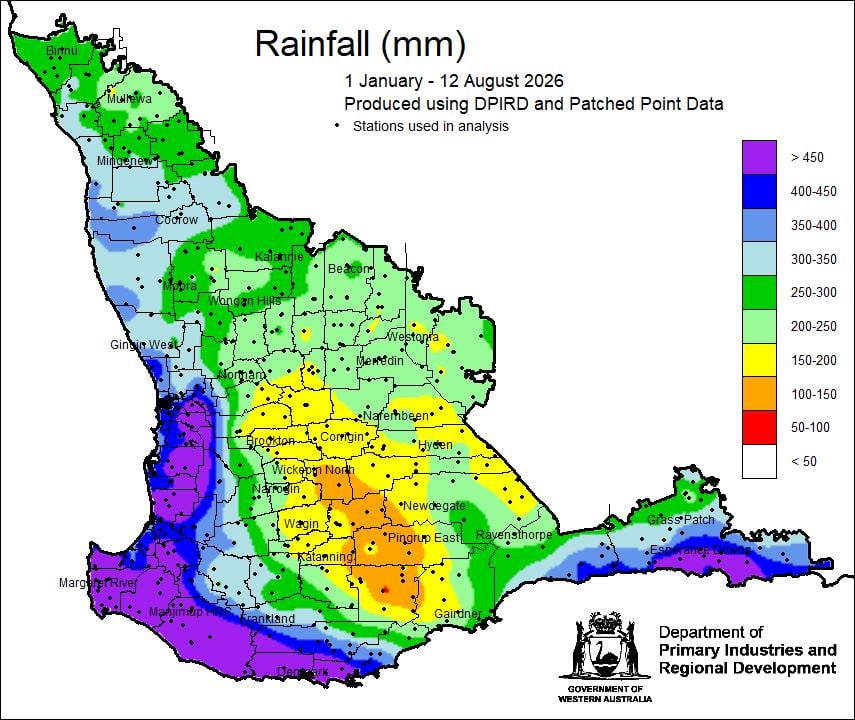
This map shows total rainfall across the South West Land Division so far in 2026.
Rainfall has varied widely, from high totals in the south-west to much lower levels in inland grain-growing areas.
This map shows how 2026 rainfall compares to past seasons using historical records (1975-2025).
It highlights areas experiencing above average, average, or below average seasonal conditions.
This map provides an estimate of soil water available to crops based on rainfall and evaporation.
It gives an indication of how seasonal conditions may be influencing crop growth across different regions.
Climate resources
- DPIRD's statewide weather stations (real-time)
- DPIRD's Rainfall to date tool
- DPIRD's Soil water tool
- BoM: Southern weekly rainfall bulletin
- BoM: Northern and Eastern rainfall bulletin
- BoM: Water and land
- BoM: Long-range forecasts summary & video
- Animated global weather conditions affecting WA
- BoM: Recent and historical
Livestock
- Contact your local DPIRD field vet to report unusual disease signs, abnormal behaviour or unexpected deaths in your livestock.
- Many areas of the Wheatbelt have received much lower-than-average rainfall for the growing season, resulting in low dam levels and reduced pasture production. Formulate or re-visit feed and water budgets, along with your cashflow budget, and put plans in place ahead of time to manage stock numbers, grain/pellet and hay availability, and water availability for the summer/autumn ahead.
- Be aware of the symptoms of Annual Ryegrass Toxicity (ARGT). It is important that purchased cereal and meadow hay is tested for ARGT.
- See the latest StockedUp newsletter for a range of seasonal production advice and management tips.
- Do not graze pastures to a residual Feed on Offer (FOO) below 600-700 kg DM/ha. Refer to Pastures from Space for current and historical FOO and pasture growth rates for your property.
- Where possible rotationally graze pastures allowing rest for improved growth rates and loss of desirable forages due to selective grazing.
- Consider applying nitrogen fertiliser to grassy pastures if spring pasture growth rates are poor to increase summer dry feed. Apply prior to decent rainfall.
- Check the updated Timerite date at TIMERITE to control red legged earth mites this year.
- Where there is excess feed, targeted use of selective herbicides can reduce weeds and increase legume content and seed production. Using a low rate of phenoxy herbicide followed by intensive grazing (known as the spray-graze technique) can be used to control broadleaf weeds in established subterranean clover. Annual grasses can be controlled with a range of selective herbicides but should be part of an integrated weed management strategy to reduce the risk of herbicide resistance. Always check product labels, as herbicide tolerance varies significantly between different annual and perennial legume species. Chemical application combined with adequate soil fertility (particularly phosphorus and potassium) and rotational grazing can help legumes naturally outcompete remaining weeds.
- Lamb marking should be carried out between 2 and 12 weeks of age. A 5-in-1 or 6-in-1 vaccination should be used with a follow up dose at weaning. Pain relief options such as anti-inflammatories and local anaesthetics are also available for lamb marking and mulesing.
- Weaning should be undertaken 12 weeks from the start of lambing (or sooner in a poor season) to help with ewe re-gaining condition before the next joining. Weaners should be 40% of adult liveweight at weaning. If many are lighter, consider managing the tail of the mob separately. Ensure follow-up vaccinations are given at weaning.
- With ram sales season starting, be sure to use Australian Sheep Breeding Values (ASBVs) paired with visual assessment for conformation to purchase rams that match your breeding objective.
- Review parasite control programs, monitor worm burdens through faecal egg counts and drench if necessary. Weaners should be drenched at weaning or early summer.
- Warmer daytime temperatures and low wind have meant flystrike is occurring in some areas. Be alert for signs, have treatment options on hand and chemical rotation plans to manage resistance, considering cross-over with worm and lice chemicals.
- In wetter areas, foot abscesses may become an issue. Keep an eye out for signs such as lameness. Foot abscesses normally only affect one foot, however the signs can also look like footrot, which is a reportable disease, so contact your local DPIRD field vet to investigate.
- It’s important to get ewes back up to condition score 3 after weaning, and prior to joining. This ensures greater reproductive potential next season. Assess ewes using MLA’s Fit to Join assessment, which involves assessing the udder, condition score, feet and mouth to make decision about a ewe’s fitness to join.
- Review sire performance. Use joining and pregnancy test results to assess which sires delivered the best outcomes. Begin planning for spring bull purchases or semen orders to secure preferred genetics.
- Energy supplementation may be required until Feed On Offer (FOO) reaches levels that support maintenance and lactation. Prioritise young cows and first‑calvers to prevent condition loss.
- Support cows with calves at foot during peak lactation. Assess cow condition regularly and ensure adequate energy intake. If feed is limited, early weaning or creep feeding may help maintain cow fertility heading into spring.
- Plan for dry‑season resilience in pastoral regions where rainfall may still be variable. Use seasonal outlooks, feed budgeting tools and decision guides to evaluate options such as destocking, agistment or holding core breeders.
- Implement winter parasite control with a focus on internal parasites, which increase with cooler, wetter conditions. Conduct worm egg counts, review drench strategies for young stock, and monitor for lice or ticks depending on region. Maintain strong biosecurity practices to reduce disease risk.
Animal welfare
- What are my animal welfare responsibilities? - information and resources
- For areas with low dam levels and concerned about water quality, visit the Water for livestock.
Crops
- With nitrogen (N) in tight supply, (1) establish your paddock nitrogen supply; (2) understand your breakeven yield/cost combination; and (3) spread your fertiliser according to responsiveness in the remaining paddocks. Listen to the Grains Convo podcast for discussions around this for wheat and canola.
- Explore how to adjust inputs to maximise economic yield potential, not just crop yield. Tune in to Grains Convo episodes on balancing yield and profit this season.
- It’s a great year to do N rate trial strips on your farm to assist you to make better decisions in following years. Read more on Making N applications pay this season (GRDC). You need to have at least 4 rates (including no N) for a useful response curve to fertilisers and replication gives you confidence in your treatment effects.
- For information to identify and manage crop pests and diseases throughout the season refer to PestFacts WA cropping resources.
- There are reports of high mouse activity in WA's agricultural regions. Check out these resources for management options to reduce risks to emerging crops: Mouse management (GRDC) and Mouse control (CSIRO)
- Landholders and regional communities are encouraged to report mouse sightings through MouseAlert (FeralScan) to help track changes across affected local governments and support the broader industry.
- The State Government has announced $200,000 in funding to support regional communities impacted by extreme mice populations. Grants of up to $10,000 are available to affected local governments for baiting, trapping and clean-up measures. View the media statement.
- Baiting may be considered at seeding where high mouse activity has been identified. In addition to the registered ZnP25 bait, the APVMA is also permitting the use of high-strength control measures (ZP50) to manage current unprecedented mice levels. To support permit conditions, Grain Producers Australia is coordinating online training to help accelerate program delivery. Products must be used in accordance with the label instructions and any adverse effects, including lack of efficacy, should be reported via the APVMA website.
- To protect community health and safety, residents should follow the latest WA Department of Health advice on managing mice infestations and using pesticides safely.
Soils
- Fertiliser decisions are being adjusted to accommodate availability and yield potential. The economically optimum rate for fertiliser depends on the yield response to applying the fertiliser, and the prices of fertiliser and grain. Flat economic response curves are common, where a wide range of fertiliser inputs provide a similar profitability when analysed annually. To learn more, read Economics of fertilisers.
- The Fertiliser management toolbox sets out a relatively easy and reliable approach for measuring and interpreting fertiliser efficiency and profitability at the paddock scale to support deciding on what returns are acceptable for your business.
Season 2026 – information for pastoralists
Latest updates and advice
- Primary producers impacted by Severe Tropical Cyclone Narelle may be eligible for disaster relief assistance. Visit Disaster Recovery Funding Arrangements for more information.
- Be aware of the symptoms of Annual Ryegrass Toxicity (ARGT). It is important that purchased cereal and meadow hay is tested for ARGT.
Holding or selling breeding cattle
- In a dry season where feed, water and finances are limited, removing less productive animals as soon as possible is a good option. This will free up feed for more productive animals and help preserve ground cover. View the Holding or selling breeding cattle in the rangelands factsheet for more information.
- Read more on body condition score, heifer management and breeder management in the Breeder and heifer management for rangeland cattle factsheet.
Grazing to reduce soil erosion
- Grazing of sheep in the pastoral areas of Western Australia: best management practice guidelines
- Grazing of cattle in the northern pastoral areas of Western Australia: best management practice guidelines
- Procedures for rangeland condition assessment in the Pilbara and southern rangelands 2025.
Welfare considerations
- Stock owners and managers have an obligation to ensure animal welfare including sufficient food, water and shelter is provided. Read more on Drought Feeding and Management of Cattle guide.
- Where sufficient food and/or water requirements cannot be met, management decisions should be made early. Cattle should be moved to where feed and water is sufficient, or they should be sold or humanely destroyed. Read more on What are my animal welfare responsibilities?
Feeding requirements
- Feeding Livestock (Agriculture Victoria)
- Drought feeding and management of beef cattle (Agriculture Victoria)
- Full handfeeding of beef cattle (NSW DPI)
- Checklist for good beef cattle health and management in drought (NSW DPI)
Livestock water requirements
- Water is a critical component in livestock productivity and welfare. To help you manage and budget your stock water accordingly, visit the Water for livestock webpage.
Transport
- Are sheep and cattle fit to be sold at a saleyard?
- Are sheep and cattle fit to load?
- Assessing beef cattle body condition for transport or sale at a saleyard
- Assessing sheep body condition for transport or sale at a saleyard
- Body condition score for beef cattle - FutureBeef
Support
- Find out more about available funding and support services.
Funding and support services
Support services are available to assist rural people in stressful situations, these include:
- Regional Men’s Health Initiative
- Rural Aid
- Lifeline
- Beyond Blue
- Rural West financial counselling service.
More information can be found on WA's rural support services directory.
View the rural support services directoryContact us
-
Christine Zaicou-KuneschFarming Systems ManagerGascoyne & Mid West